
Graph Engineering at Novelyst: How an AI Writing Workflow Takes Shape
A scene can work beautifully on its own and still cause trouble for the rest of a novel. A character learns something too soon. A reconciliation arrives before either person has earned it. A small change to a conversation quietly removes the reason for a decision three chapters later.
Writers deal with these problems throughout drafting and revision. As we write, we move intuitively between the immediate passage and the larger work, asking what belongs, what follows, and what needs another look. Editing a sentence and reconsidering an ending require different kinds of attention, even when the same person does both.
An AI writing system needs a way to organize that work. It must decide which task to undertake, what information to supply, how to assess the result, and what should happen when a problem appears.
These are the questions behind graph engineering. At Novelyst, they connect the practical work of building software with the editorial work of developing a novel.
What Graph Engineering Means
In this context, a graph is a map of work and the connections between tasks. Graph engineering makes those connections explicit: which tasks exist, how information passes between them, and which conditions determine the next step.
Three terms are useful. A node is a task, such as developing a scene plan or reviewing a chapter. An edge connects tasks and determines the route through the process. The state is the information the workflow maintains as it proceeds.
A simple example is a draft moving to review. If the review identifies a problem, the route can return the draft for revision. The revised version can then be checked again. The route includes a decision based on the work produced so far.
Across a novel, that coordination becomes especially important because decisions made early in the manuscript can affect material written much later.
For a novelist, the useful question is what that coordination helps preserve: the intended structure, the distinction between characters’ knowledge, the consequences of earlier choices, and the voice of the work.
Giving Each Task a Defined Responsibility
Novelyst’s workflow separates chapter planning, scene development, chapter writing, review, and surface editing. Each has a defined assignment and its own instructions.
The chapter planner translates the supplied story material into an ordered plan. It assigns narrative functions, developments, and obligations to chapters. Scene development works within that plan, identifying the actions, interactions, and transitions through which a chapter can unfold. The chapter writer then develops the assigned material into prose.
The reviews bring different questions to that work. Developmental review considers structure, pacing, character choices, and consequences. Continuity review checks matters such as chronology, movement, knowledge, relationships, and possession of important objects. Surface editing covers style, sentence craft, grammar, and proofreading in one coordinated pass.
These responsibilities give the system a basis for judging what kind of intervention is appropriate. A continuity reviewer needs to identify a contradiction accurately. A surface editor needs to improve a sentence while preserving what it means. Crucially, neither is an invitation to redesign the premise.
Editorial delegation remains the guiding principle. The exact grouping of tasks can change as the system develops, while the distinctions between their purposes remain useful.
Deciding What Happens After Review
An instruction can tell a reviewer to check whether a plan includes the ending. The workflow must also determine what happens if the ending is missing.
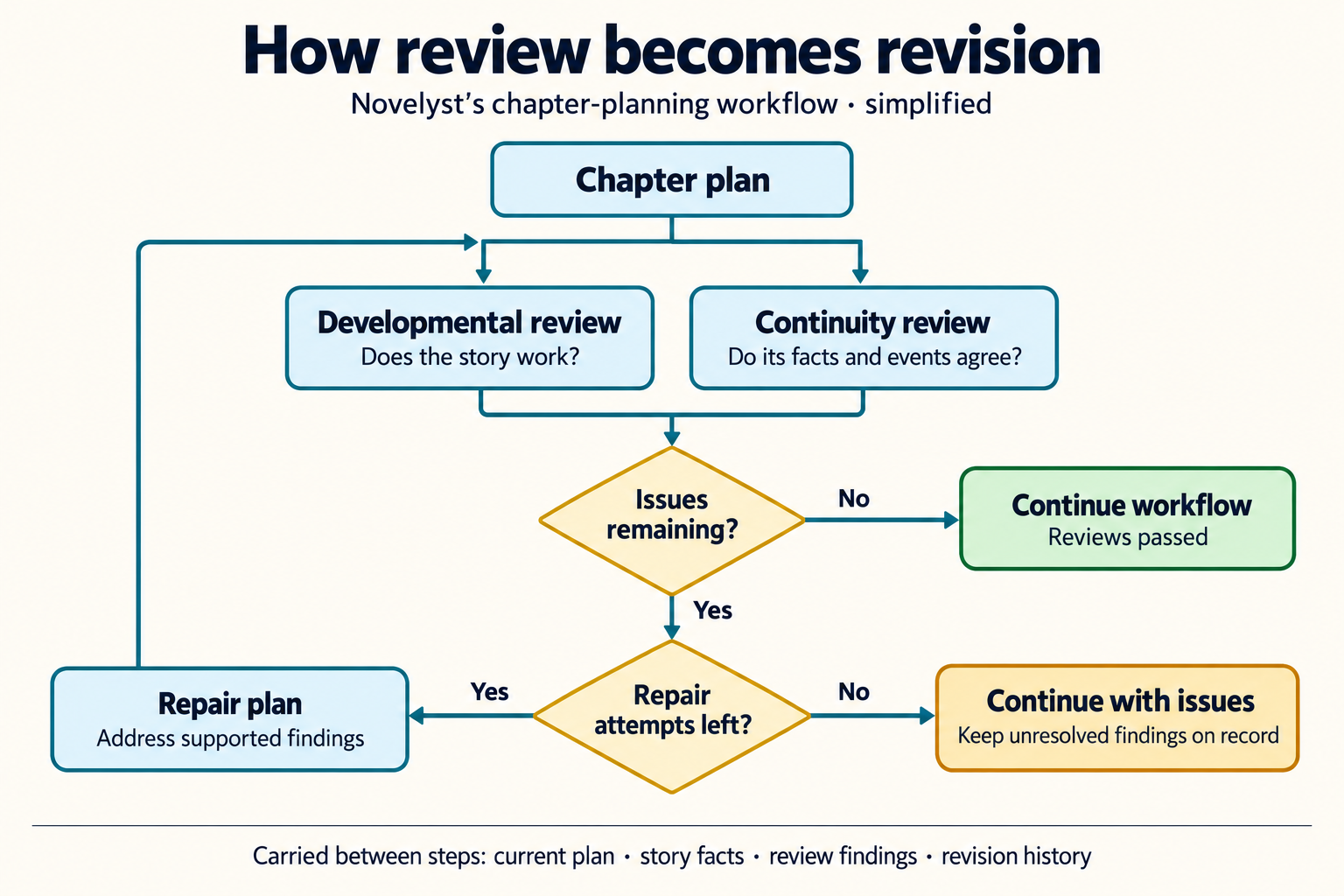
In Novelyst’s planning process, developmental and continuity reviews feed into a resolution step. Problems can lead to plan repair and another round of review. The records retain the findings and the version being assessed, allowing the next task to work from specific evidence.
This is where graph engineering extends beyond the wording of an individual prompt. A reviewer produces a judgment and the surrounding workflow uses that judgment to determine how work proceeds.
Revision also needs limits. Repeated review can consume time and resources without resolving the original problem, and a proposed correction can introduce difficulties of its own. A workflow therefore needs an explicit policy for ending repair attempts.
Novelyst’s planning records distinguish a clean review pass from continued work after repair attempts have been exhausted. In the latter case, unresolved findings remain recorded. That distinction matters: completing a stage does not establish that every quality concern has been settled.
The value of the graph lies partly in making these decisions visible and consistent enough to examine. It provides a structure within which the quality of the reviews and repairs can itself be assessed.
Keeping Track of What the Story Establishes
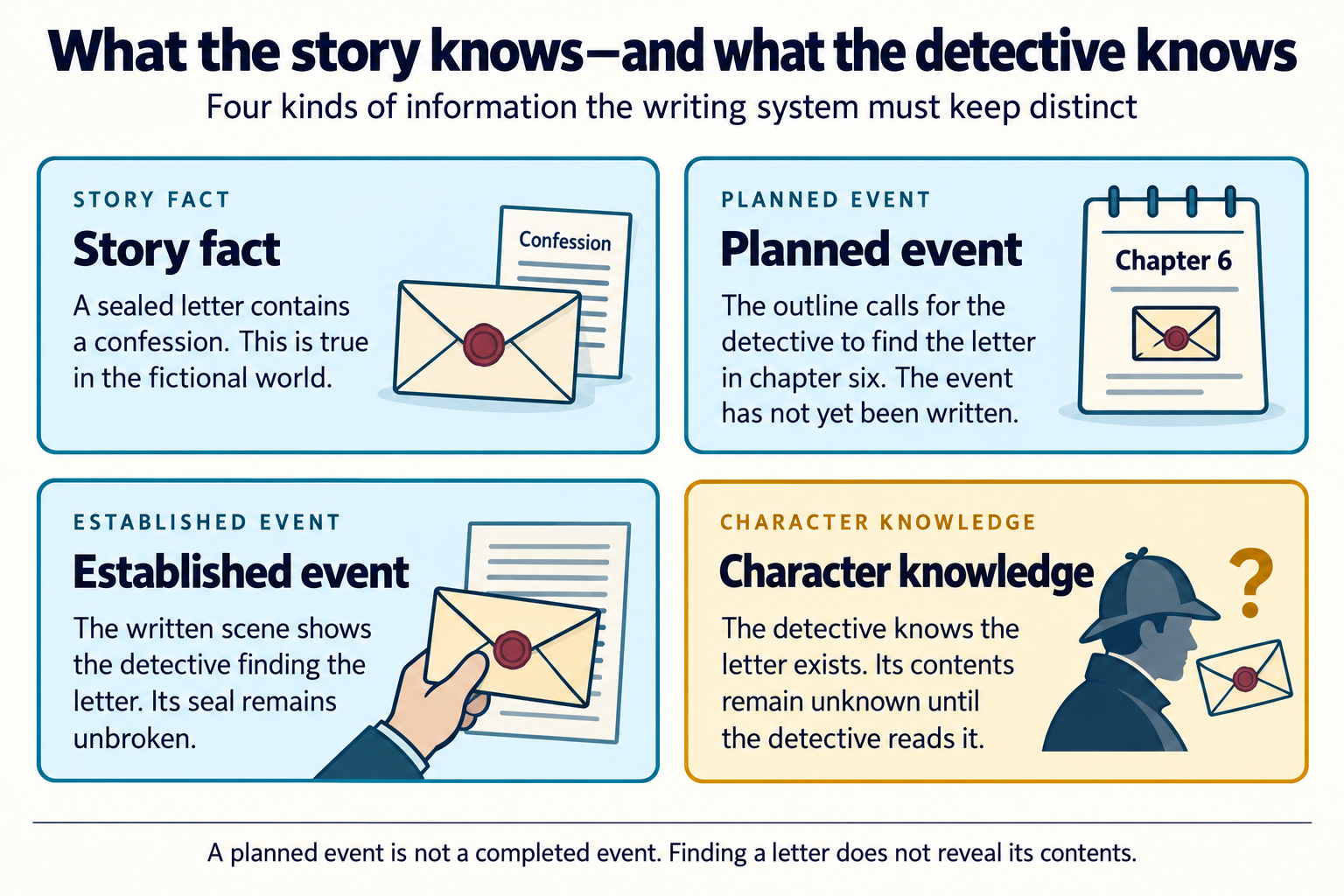
Consider a mystery in which a detective is meant to discover a letter in chapter six. The outline records its location and contents. By chapter four, that information exists in the project, but the detective has not encountered it.
If the chapter-four dialogue relies on the letter, the story has skipped a necessary discovery. If chapter six fails to dramatize the discovery, later chapters cannot safely assume it happened merely because the outline required it.
The system must distinguish several things: a fact about the fictional world, an event planned for later, an event established in the prose, and something a particular character knows. Those distinctions determine which reactions and decisions are credible.
Novelyst’s shared instructions explicitly separate these categories. They also establish a priority for user-defined story facts and constraints, including the required plot structure. Plans and editorial advice must work within those commitments.
This organization gives later tasks a clearer basis for continuing the story. It helps prevent a planned revelation from becoming premature knowledge, or an omitted event from quietly acquiring the status of something already completed.
For long fiction, remembering information includes remembering how that information became relevant and who has access to it.
Revising Without Losing Effective Writing
There is a temptation, when designing an automated review process, to treat every suggested change as progress. Writers and editors know how quickly that assumption can fail. An explanation can flatten subtext. A smoother sentence can weaken a distinctive voice. An attempt to clarify a character’s motive can remove an ambiguity the story needs.
Novelyst’s review instructions require evidence and an account of the problem’s effect on the reader. They allow work to pass unchanged where appropriate. They also distinguish a diagnosis from its proposed remedy: a reviewer may identify a real problem and still suggest the wrong solution.
Repair instructions carry that distinction forward. Findings must be checked against the current version before changes are made. A criticism may have been addressed already, or it may conflict with another requirement. Reapplying it without checking can damage material that now works.
Surface editing has a narrower remit. Its instructions protect events, character intent, knowledge, relationships, and other aspects of story meaning. A problem that requires changing those elements belongs in narrative review. That boundary helps keep a local wording edit from becoming an unexamined plot change.
These rules express an editorial judgment about restraint. Effective writing deserves preservation, and revision should have a reason beyond the availability of another pass.
Making the Process Inspectable
When a manuscript develops a problem, the final text alone may not explain where it began. The plan might have omitted a required event. Scene development might have weakened it. The writer might have summarized something that needed to occur on the page.
Novelyst’s graph admin view allows the team to inspect individual tasks and their recorded prompts and responses. Planning reviews and repair rounds can be examined together, alongside execution details such as the model used, time taken, and token usage.
That visibility gives prompt engineers and editors a more specific starting point for improvement. They can examine what a task received and produced, then compare it with the review that followed. It becomes possible to investigate whether the instructions were unclear, the supplied information was insufficient, or a correction failed to address the problem.
The same records can help identify unnecessary work. A reviewer that repeatedly objects to effective passages needs attention just as much as one that overlooks contradictions.
What This Means for the Writer
Most writers using Novelyst will have little reason to think about nodes, routes, or revision counters. Their concerns are more immediate. Does the chapter fulfill its purpose? Does a character’s response follow from what they know? Has the revision preserved the passage they wanted to keep?
Graph engineering gives the development team a way to organize those concerns into tasks with defined responsibilities, relevant information, and explicit routes for review and repair. Its success still depends on the judgment exercised within those tasks. Adding stages does not establish that the resulting novel is better; the writing needs to bear that out.
Novelyst’s approach brings editorial delegation into the design of the workflow itself. Planning, drafting, and editing receive different assignments, while the connections between them preserve the context needed to continue the work.
A novel develops through many decisions, some local and some with consequences across the book. The purpose of this engineering is to give those decisions a process that can support them.